Thursday, February 26, 2015

LAVENDER-GLAZED DUCK WITH BLACKBERRY PORT WINE SAUCE


This lavender-glazed roasted duck recipe is adapted from Chef Daniel Humm's signature dish that is served at Eleven Madison Park and is published in his cookbook of the same name. Duck is rubbed with lavender honey then coated with a spice mix consisting of Szechuan peppercorns, dried coriander seeds, cumin seeds, and dried lavender buds. 

And for a sauce, I created a blackberry and port wine reduction using thawed, frozen blackberries and Fonseca Port Bin 27.  The blackberries are thawed and drained and all excess water is removed and then the blackberries are placed into a pan with the port.  The mixture is reduced, pureed and strained to remove the seeds from the blackberries.  The reduction is then placed back into the pan and unsalted butter is whisked in slowly.

Side dishes to consider for this are:  Roasted carrots, wild/brown rice, peach confit

Lavender Spice Mix
1/4 cup Szechuan peppercorns
1/4 cup dried coriander seeds
1/8 cup cumin seeds
1/4 cup dried lavender buds

In a spice grinder, grind the Szechuan peppercorns, dried coriander seeds, and cumin seeds until roughly ground.  Transfer to a bowl and stir in lavender buds.

Roasted Duck
1 3-pound duck
1 cup lavender honey
Lavender Spice Mix

Remove fat deposits and giblets from duck cavity, reserving liver.  Trim excess skin and fat from neck area.  Rinse inside and out; pat dry.  With a fork, prick holes in duck breast through the fat, ensuring not to prick through to the meat.

Remove wing tips.  Rub lavender spice mix inside the duck cavity and put the liver inside the cavity.  Truss the duck with butcher's twine.  Rub the outside of the duck thoroughly with lavender honey.  Then coat the duck evenly with Lavender Spice Mix.

Add a little drizzle of olive oil to bottom of roasting pan, then place duck in the pan in a 350 degree oven for 20 minutes.  Continue to roast duck at 20-minute intervals turning duck 1/4 turn each time.  Total roasting time is 1 hour and 20 minutes.  When done, remove duck from oven and let it rest for 10-15 minutes before carving.  Transfer duck to platter.  Remove liver and mash finely in small bowl.  Mashed liver could be served on baguettes.  Serves 2


Blackberry and Port Wine Sauce
1 cup frozen blackberries, thawed, drained and excess water removed
1/2 cup Fonseca Port Bin 27
2 Tablespoons unsalted butter, cut into quarters

Put blackberries in pan with port.  Reduce mixture to 1/2 cup.  Puree in food processor.  Strain mixture through sieve to remove seeds from blackberries.  Return strained sauce to pan on low heat.  Slowly mix in the butter, one piece at a time, until blended, and shiny.  Keep warm.

Side dishes: 
Roasted Carrots:  Add peeled carrots to the duck while it is half-way through the roasting process.  The carrots absorb all of the flavors from the duck fat/juices.

Wild and Brown Rice:  A mixture of wild and brown rice, cooked separately, always goes well with duck and is a perfect enhancement to the dish.

Peach Confit:  Another adaptation to part of Chef Humm's recipe is peaches that have been roasted slowly in the oven with a sprinkling of olive oil and lime juice:

          For Peach Confit:
          2 large peaches
          1 Tbsp olive oil
          1 Tbsp lime juice
          Black pepper

          Preheat the oven to 200 degrees F. 
          Cut each peach into quarters. Cut each quarter into 3 ½-inch sections. Line a rimmed baking sheet with parchment paper. Arrange the sliced peach segments on the baking sheet and drizzle olive oil and lime juice on peaches.  Sprinkle with pepper. Bake for 45 minutes.
 

Friday, January 30, 2015

BOUILLABAISSE


Bouillabaisse in Lobster Stock
There are as many different versions of Bouillabaisse as there are fish in the sea.  In this version, I used only shrimps, mussels, clams, calamari, and a lobster tail.  The seafood stock should be home-made, but I've seen versions of Bouillabaisse made with clam broth.  In this recipe, I used home-made lobster stock.

Bouillabaisse, or fishermen's stew, originated in the Provence region of France in the city of Marseilles.  The fishermen would create a stew from the fish they were unable to sell at the local markets.   Onions, celery, leeks, fennel and tomatoes are simmered in a seafood broth and served with the fish.  But what makes a bouillabaisse different from other fish stews is the herbs and citrus essence that help enhance its flavor.

Bouillabaisse is traditionally served with a Rouille, a mayonnaise made of olive oil, garlic, Dijon mustard and cayenne pepper.  It is served with grilled slices of crusty bread.

I like to serve my Bouillabaisse directly from the pot.  The Rouille and bread are served separately on the side.  Serves 2

For the Bouillabaisse:
2 Quarts of Lobster Stock (or Seafood stock)
Pinch of Saffron Threads
1 cup leeks, julienned
2 cups tomatoes, peeled, seeded, and chopped
Juice and zest of one orange
1 cup fennel, julienned
2 tablespoons garlic, chopped
2 tablespoons parsley, finely chopped
1 calamari body, cleaned (about 8 oz)
6 littleneck clams
1 pound mussels
8 Jumbo (U-15) shrimp, peeled and deveined
1 lobster tail

In a large Dutch oven, heat seafood (or lobster) stock over medium/high heat and then bring to a simmer. Add the saffron, leeks, tomatoes, orange juice, orange zest, fennel, garlic, and parsley. Season with salt and pepper. Add the calamari and clams and cook for about 3-4minutes. Add the shrimp and mussels and lobster tail. Cook for 5-6 minutes, or until the shells have opened.  Discard any shells that do not open.

For the Rouille:
1 red pepper, roasted and peeled
3 garlic cloves
1 cup crust-less bread cut into cubes
1 egg yolk
1/8 teaspoon cayenne pepper
1/2 tablespoon Dijon mustard
Juice of one lemon
1/2 cup olive oil
6 slices of crusty bread

In a food processor, combine all the ingredients, except for the oil. Puree until smooth. With the machine running, slowly add the olive oil.

To Serve:
The Bouillabaisse could be served directly from the pot or the seafood could be removed from the pot and placed on a large platter. Pour the stock into a serving bowl. Serve the Rouille and crusty bread on the side of the Bouillabaisse.


TURKEY MUSHROOM LOAF WITH ROASTED RED PEPPER TOMATO SAUCE


This is another version of my turkey meatloaf.  For this one, we added cumin and included a sauce made with roasted red peppers, roasted tomatoes and baked garlic.  The result was a turkey mushroom loaf that was light, moist and flavorful. 

Ingredients
1 1/2 cups finely chopped onion
2 Tablespoons minced garlic
1 teaspoon olive oil
1/2 pound cremini mushrooms, trimmed and finely chopped in a food processor
1/2 teaspoon cumin
1/4 teaspoon black pepper
1 1/2 teaspoons Worcestershire sauce
1/3 cup fresh parsley, finely chopped
1 cup Roasted Red Pepper Tomato Sauce, divided (recipe follows)
1/2 cup Panko (Japanese bread crumbs)
1/4 cup low-fat milk
1 egg, lightly beaten
1 pound lean ground turkey

Preparation
Preheat oven to 400°F.

Cook onion and garlic in oil in a 12-inch nonstick skillet over moderate heat, stirring, until onion is softened, about 2 minutes. Add mushrooms, 1/2 teaspoon cumin, 1/4 teaspoon black pepper and cook, stirring occasionally, until the mushrooms are tender, 10 to 15 minutes. Stir in Worcestershire sauce, parsley, and 1/2 cup Roasted Red Pepper Tomato Sauce.   Transfer mixture to a large bowl and cool.

Stir together Panko and low-fat milk in a small bowl and let stand 5 minutes. Stir in egg and then add to mixture. Add turkey and mix well.  

Form into a 9- by 5-inch oval loaf in a lightly oiled baking pan.  Brush loaf evenly with Roasted Red Pepper Tomato Sauce. Bake in middle of oven until thermometer inserted into loaf registers 170°F, about 50 to 55 minutes.

Let loaf rest 5-10 minutes.  Heat remaining Roasted Red Pepper Tomato Sauce and use as a topping on sliced portions.

ROASTED RED PEPPER TOMATO SAUCE
Ingredients
1 small head garlic
1/2 pound tomatoes, blanched and skins removed, cut in half
1 large red bell pepper, lightly coated with olive oil
1 teaspoon olive oil
1 1/2 teaspoons fresh lemon juice
1/2 teaspoon balsamic vinegar

Preparation
Preheat oven to 375°F.

Cut off and discard top quarter of garlic head and wrap remainder in foil. Arrange tomatoes, cut sides up, in a foil-lined baking pan. Add whole bell pepper and garlic (in foil) to pan and roast vegetables in middle of oven for 30-40 minutes.

Remove from oven and let vegetables rest as bell pepper cools down, about 20 minutes. When cool enough to handle, peel pepper, discarding stem and seeds.  Transfer both pepper and tomatoes to a food processor or blender.

Unwrap garlic and squeeze roasted cloves from skin into food processor. Add olive oil, lemon juice, and balsamic vinegar. Puree sauce until smooth.

Thursday, November 20, 2014

BOURBON BLOODY MARY WITH DUCK BACON


Whenever we hear Bloody Mary, our immediate reaction is a popular brunch drink served with vodka and tomato juice garnished with a celery stalk.  Although there are conflicting claims of who invented the original drink, it has become one which has evolved over the years and many variations have become prevalent.  This one, on the other hand, uses bourbon instead of vodka and it is garnished with duck (or turkey)bacon. 

Ingredients:
Bourbon smoked pepper
1 lemon wedge
2 oz premium bourbon
4 oz tomato juice
2 dashes Tabasco sauce
2 tsp prepared horseradish
2 dashes Worcestershire sauce

Garnish: Cooked duck bacon

Glass: Pint

To Finish:
Pour some bourbon smoked pepper onto a small plate. Rub the juicy side of the lemon wedge along the lip of a pint glass. Roll the outer edge of the glass in smoked pepper until fully coated. Fill with ice and set aside. Squeeze the lemon wedge into a shaker and drop the wedge in. Add the remaining ingredients and fill with ice. Shake gently and strain into the prepared glass. Garnish with the duck bacon.


Monday, November 17, 2014

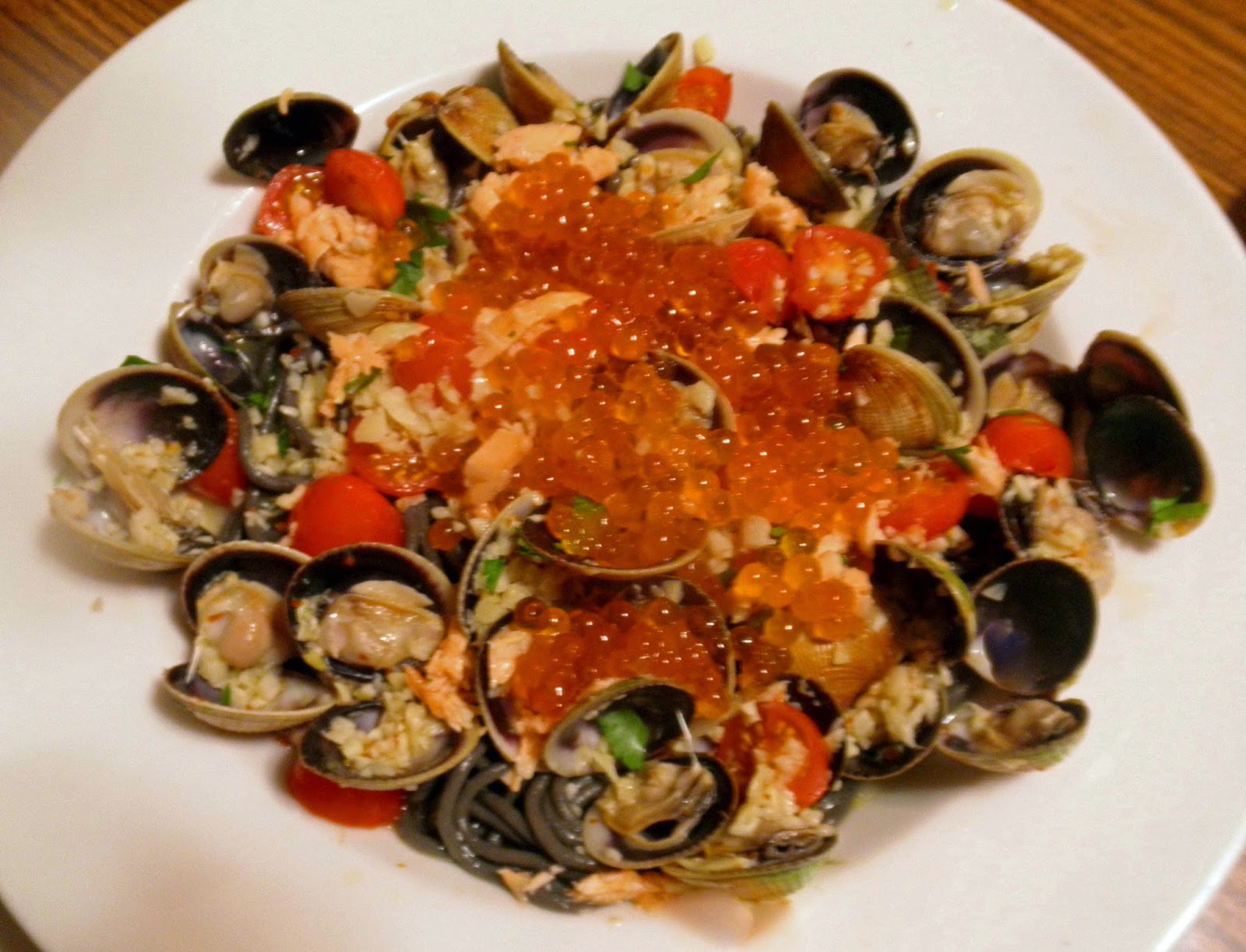
SQUID INK SPAGHETTI WITH NEW ZEALAND COCKLES AND SALMON ROE


Whenever I see squid ink pasta at the market, I have to get it.  And since I was in Lobster Place at Chelsea Market, I couldn't resist purchasing a package of the di Nero Squid Ink Spaghetti.  Across the aisle were some beautiful New Zealand cockles, so the dish that immediately came to mind was squid ink spaghetti with New Zealand cockles.  On the other side of the store were jars of salmon roe, so I thought about topping the dish with the salmon roe as a garnish.  And since I also purchased a gorgeous piece of center-cut Atlantic salmon, I cut off the 1/4 inch part of the salmon and cooked that and used it as an additional garnish.  Another seafood Sunday.


1/4 pound Spaghetti di Nero Squid Ink
3 Tablespoons olive oil
6 garlic cloves, minced
1/2 teaspoon pepperoncino (medium hot crushed red pepper flakes)
1 cup dry white wine
1 pound New Zealand cockles, scrubbed
10 grape tomatoes, halved
1/3 cup finely chopped flat leaf parsley
1 ounce cooked salmon, chopped (optional)

Bring a large pot of water to a boil.  Add salt.  Drop the spaghetti into the boiling water; stir to keep spaghetti from sticking together.  Cook until al dente according to package directions. Drain spaghetti when done.
 
 
Meanwhile, heat oil in a 12- to 14-inch heavy skillet over medium-high heat until it shimmers.  Add garlic and pepperoncino and cook for 1 minute, being careful not to let the garlic brown.  Add white wine and let simmer for another minute.  Add cockles and stir until well coated; cover tightly.  Check cockles frequently after 2 minutes, transferring with a slotted spoon to a bowl as cooked (discard any that remain unopened after 6 minutes).


Add tomatoes to juices in skillet with 1/3cup parsley, stirring occasionally, until liquid is reduced, about 3-6 minutes.

Place spaghetti on a serving platter then pour cockles and juice onto spaghetti.  Garnish with salmon roe and shredded cooked salmon (optional).


Sunday, October 5, 2014

HALIBUT NUGGETS WITH HAZELNUT CRUMB CRUST AND SAUTEED LOBSTER MUSHROOMS

Halibut Nuggets
A Pacific Northwest theme is going on in this dish.  Recently, we purchased fresh wild Alaskan halibut at the fish monger and a beautiful large lobster mushroom at the produce market. Halibut is one of my favorite finfish from the Pacific Northwest and its peak season is from April until October.  And the Pacific Northwest is one of the main growing regions for lobster mushrooms, which are widely available in September and October. I've been eyeing the lobster mushrooms for many years whenever they were at the market, so now was the time to give them a try. 

The halibut recipe is adapted from the Pike Place Public Market Seafood Cookbook. Halibut is a finfish that is high in protein, low in calories and easy to cook. The halibut is cut into chunks and dipped into a honey-mustard mixture, then coated with a hazelnut-crumb mixture and baked in the oven for about 10 minutes.  The end result is a very moist and succulent fish.
 
 
And the lobster mushrooms, surprisingly, are not mushrooms but a fungus that grows on certain species of mushrooms, turning them a reddish orange color that resembles the outer shell of a cooked lobster.  They have a seafood-like aroma when cooking and a firm, dense texture.   When sautéed, their succulent meat hints pleasantly at seafood. We simply sautéed the mushrooms in butter with fresh thyme sprigs.

For the Halibut:
Yield:  Serves 2
2 Tablespoons Dijon mustard
2 Tablespoons soy sauce
2 Tablespoons butter, melted
1 Tablespoon honey
1/4 cup Panko (or unflavored bread crumbs)
1/4 cup finely chopped hazelnuts
2 teaspoons minced cilantro
3/4 pound halibut, skin removed, cut into 8 pieces
Olive oil
Kosher salt
White pepper

Preheat oven to 450 degrees.  Lightly coat a baking sheet with oil. Set aside.

In a small mixing bowl, stir together the mustard, soy sauce, butter, and honey.  In another small bowl, mix together the panko bread crumbs, hazelnuts, and minced cilantro.

Lightly sprinkle halibut pieces with salt and pepper.  Dip the halibut nuggets in the honey-mustard mixture, allow excess to drain off and then coat with the hazelnut-crumb mixture.  Place nuggets on the baking sheet without crowding.
 
 
Bake the halibut nuggets for 8-12 minutes, or 10 minutes per inch of thickness.  The fish should just turn opaque.  To test for doneness, cut into the center of one nugget with the tip of a small, sharp knife and pull apart slightly. 

For the Lobster Mushrooms:
Yield:  1 cup mushrooms


1 large lobster mushroom (about 12 oz)
3/4 stick unsalted butter
2 sprigs fresh thyme

Place lobster mushroom in a bowl of cold water for several minutes.  Remove from water and cut the mushroom in half.  Wipe off and clean the brown spots on the outer parts and in the flesh of the mushroom and remove the hard bottom part.  Slice into 1/4 inch pieces and set aside.
 
Melt butter in a pan.  Add mushrooms to pan with thyme sprigs.  Sauté mushrooms, turning occasionally, until mushrooms are cooked through. Remove thyme sprigs before serving.
 
 
To Finish:
Serve halibut nuggets with the sautéed mushrooms and their pan juices as a side, or place a mushroom slice on each halibut nugget and drizzle with some of the pan juice.  The nugget with the mushroom slice on top is a perfect one-bite experience loaded with intense flavors.

Monday, September 29, 2014

HONEY AND MUSTARD MARINATED NORWEGIAN SALMON WITH THYME AND ROSEMARY APPLES

 
Norwegian Salmon
 After purchasing Norwegian salmon at the market the other day, only one thought entered my mind.  And that was Andreas Viestad and his Kitchen of Light cookbook.  When I arrived home, I perused the book and found one of his favorite salmon recipes that piqued my interest:  Honey and Mustard Marinated Norwegian Salmon with Rosemary Apples.


However, I was taken aback by salmon being served with apples.  Apples?  So I threw away my thoughts about salmon and lentils that day and made it, and I was pleasantly surprised.  I added sprigs of fresh dill to the marinade and fresh thyme sprigs to the apples, and served it with smashed dill potatoes.  It was another great New Scandinavian Cooking dish....without the flight to Norway.

For the Salmon:
Yield:  Serves 2

1/2 pound Norwegian salmon fillet, skin on
2 Tablespoons olive oil
1 Tablespoon honey
2 Tablespoons Dijon mustard
2 garlic cloves, minced
1 Tablespoon fresh lemon juice
2 Sprigs fresh dill
Fleur de sel

Rinse fish under cold running water and pat dry.

In a shallow dish, mix the olive oil, honey, mustard, garlic, lemon juice and dill.  Place fish in mixture, turning to coat it with the marinade.  Cover and marinate for 2-3 hours in the refrigerator.
 
Salmon in Marinade
 
For the Thyme and Rosemary Apples:
Yield:  1/2 cup; serves 2

1 green apple
2 Tablespoons unsalted butter
1 sprig fresh thyme
1 sprig fresh rosemary

Peel and core the apple and cut into 8-10 slices.  Heat the butter in a large skillet over medium high heat.  Add the cut apple, thyme and rosemary sprigs.  Reduce the heat to medium and cook, turning apple slices until tender, about 8-10 minutes.  Remove cooked apple from the heat and discard the thyme and rosemary sprigs. Set aside.

To Finish:
Preheat oven to 375 degrees.

Remove salmon from refrigerator and brush off marinade.  Reserve the marinade.  Transfer the salmon to a lightly oiled baking dish, skin side down. Let salmon sit at room temperature for about 20 minutes.  Place salmon in oven.  After 8 minutes of baking, pour the reserved marinade over the salmon. Continue to bake salmon for another 4-5 minutes or until the flesh flakes nicely with a fork.  Remove salmon from oven and season lightly with Fleur de sel.

Serve alongside the apples.
 

LIGHTLY BATTERED ROCK SHRIMPS IN A CREAMY SPICY SAUCE


Rock Shrimps have always been one of my favorites.  Many restaurants serve "rock shrimp" dishes, but not all are rock shrimps, per se.  Many establishments use tiny shrimps which are coated in a thick batter and then deep fried.
 
Rock shrimps are firmer, slightly chewy and their flavor is sweet and similar to that of lobster.  They are sold without their shells and are typically available frozen year-round and are generally available fresh from July through November, peaking in September. 

Recently, I purchased some rock shrimps and wanted to make them in a "tempura" style.  However, I didn't want a layer that took away from their delicate sweet flavor, so I decided to do a very light coating of a batter, then deep fried them and tossed the shrimps in a creamy spicy sauce.   The flavor of the shrimps was not masked in a typical heavy coating while the creamy spicy sauce added a little heat that enhanced the sweetness of the shrimps.  They were light, sweet and spicy.
 
 
I adapted this recipe from Chef Nobuyuki Matsuhisa's book, NOBU NOW. First, I made a light coating for the shrimps using an egg yolk, AP flour, and seltzer.  The shrimps were then fried in canola oil and finally tossed in a creamy spicy sauce.

Batter Coating:
Yield:  1 cup

1 egg yolk
3/4 cup seltzer
1/4 cup AP flour

Lightly whisk together all ingredients to make the batter.

Creamy Spicy Sauce: 
Yield:  3/4 cup

1 egg yolk
1/4 teaspoon sea salt
 Pinch of white pepper
1 teaspoon rice vinegar
1/2 cup grape seed oil
1teaspoon sriracha sauce

Whisk together the egg yolk, salt, pepper, and vinegar, and then gradually whisk in the canola oil.  After sauce is thickened, add the sriracha sauce.

Rock Shrimps:
Serves 2

1/2 pound rock shrimps
Batter Coating
Splash of Yuzu juice
Chopped Chives
Canola oil for frying

In a heavy deep pot, place about 3" of oil (enough to cover shrimps).  Heat oil to 355 degrees.  Dredge the shrimps in the batter coating and gently place several shrimps in the hot oil, without overcrowding.  Fry shrimps until lightly golden, about 2-3 minutes.  Remove shrimps and place on a wire cooling rack.  Repeat the process until all the shrimps are cooked.

To Finish:
Place the cooked shrimps into a large bowl with the creamy spicy sauce and toss to coat.  Splash with yuzu juice, sprinkle with chopped fresh chives and serve.

Thursday, September 25, 2014

BAKED HERBED SALMON WITH LENTILS AND RED WINE SAUCE


Baked Herbed Salmon with Lentils
The first time I made Herbed Salmon with Lentils and Red Wine Sauce was in 1996.  It was from a recipe that appeared in the February issue of FOOD & WINE Magazine and has become another one of my favorite go-to dishes since then.

There are hundreds of recipes available for the classic salmon and lentils combination, but since both the salmon and lentils are prepared separately, there is a lot of flexibility and creativity for making each part.

The herbed salmon could be seared in a skillet on the stovetop, grilled on the grill, or baked in the oven. The seared or grilled versions result in a salmon with a crust, while the baked kind creates a moist herbed topping sans crust.  For this recipe, I baked the salmon, and as can be seen in the photo, there are plenty of herbs without a crust.

Any method works well and the end result is a moist pink, flaky fish inside. Of course, if someone wants the salmon to be well done, then the cooking time could be adjusted accordingly. 

And for the lentils, I tried making them several ways by first adding them to the pan covered with water and then adding the vegetables.  Alternatively, I tried sautéing the vegetables first, and then added the lentils and water or a flavored broth.   Either way, I found that they almost always never cooked as the suggested time listed in the recipes.  Typically, they would require an additional 20-30 minutes.

Finally, the Red Wine Sauce adds a slight tartness to the dish.  It does not overpower the fresh herbs or sweetness of the salmon or the tenderness of the lentils which absorb all the flavors. 

For the Salmon:
Yield:  2 Servings

2 fresh tarragon sprigs, leaves finely chopped, stems reserved
2 fresh flat-leaf parsley sprigs, leaves finely chopped, stems reserved
2 fresh chives, finely chopped
1/4 teaspoon kosher salt
Finely grated zest of 1 orange, about 1 Tablespoon
1/4 teaspoon freshly ground pepper
2 6-ounce skinless salmon fillets, about one-inch thick
Extra oil virgin olive oil (for drizzling or sautéing salmon prior to cooking)

In a small bowl, mix together the chopped tarragon, parsley, chives, kosher salt, orange zest and pepper.  Spread the herb mixture evenly on both sides of the salmon and arrange the fillets in a large baking dish.  Marinate in the refrigerator for about 3-4 hours. 

Salmon with  Herbs

For the Lentils:
Yield:  3-4 cups cooked lentils

1 1/2 cup French green lentils, rinsed and picked over
1 Tablespoon extra virgin olive oil
1 onion, peeled and chopped into 1/2 inch dice
1 carrot, peeled and chopped in 1/2 inch dice
1 celery stalk, chopped into 1/2 inch dice
4 large garlic cloves, minced
4 fresh thyme sprigs
Kosher salt, to taste (about 1/2 teaspoon)
Water, about 2-2 1/2 cups

In a medium saucepan over medium heat, heat the olive oil until it slides across the pan.  Add the chopped onions, carrots, celery, garlic, thyme sprigs and salt, and cook stirring occasionally, until the vegetables soften, about 15 minutes. 
 
Add the lentils and enough water to cover lentils (about 1-1 1/2 cups) and bring to a simmer.  Simmer until the water no longer covers the lentils, about 30 minutes.  Add salt and more water (about 1/2 cup) so the lentils are once again covered.  Continue cooking, adding more water, until the lentils are tender, about 30 minutes more.  Discard thyme sprigs prior to serving.  The lentils can be stored in the refrigerator for up to one day.  Reheat before serving.
 
Cooked Lentils
For the Red Wine Sauce:
Yield:  3/4 cup sauce

Red Wine Sauce Prep
1 cup dry red wine, such as Cabernet Sauvignon
1/2 cup port
1/4 cup red wine vinegar
1 small shallot, minced
Reserved tarragon and parsley stems
1/2 stick (2 ounces) cold unsalted butter, cut into ½-inch dice

In a non-reactive medium saucepan, combine the red wine, port, red wine vinegar, shallots and tarragon and parsley stems.  Boil over high heat until reduced to 1/2 cup, about 15 minutes.  Strain the mixture into a small non-reactive saucepan and bring back to a boil over moderate heat.  Lower the heat and gradually whisk in the butter until the sauce is slightly thickened; do not let the sauce boil.  Season with salt and pepper and keep warm.
 
To Finish Salmon:
Preheat oven to 450 degrees.

Remove salmon from refrigerator at let it sit at room temperature for about 20 minutes.*

Drizzle salmon with extra virgin olive oil and place in the oven for about 7-8 minutes, or until desired doneness.  Remove from oven and let salmon rest for about 5 minutes. 

*Alternatively, after reaching room temperature, the salmon could be sautéed instead of cooked in the oven.  Heat a large, heavy cast-iron skillet.  Brush the herbs from the salmon.  Drizzle bottom of skillet with olive oil.  Cook the salmon fillets over moderate heat, turning once until nicely browned and just opaque throughout, about 4 minutes per side. 


To Plate:
Make a bed of the lentils on each plate. Set the salmon fillets on top, spoon the red wine sauce over the fish and lentils and serve.

Herbed Baked Salmon with Lentils (Side View)


Tuesday, September 23, 2014

VODKA AND SPICY TOMATO-CREAM SAUCE WITH PENNE, KING CRAB LEGS AND SHRIMPS


This is another one of those dishes from the cupboard that I like to revisit from time to time. 

Back in 1993, Patricia Wells' recipe for Penne with Vodka and Spicy Tomato-Cream Sauce (Penne alla Bettola) from her cookbook TRATTORIA was published in The New York Times.  Although it has been more than 20 years, I still have the tattered and stained article.  I kept it for memorabilia purposes.  All, or most, of those recipes from the past are now in the computer, but many of the original paper documents have been saved as well.

For this recipe most of the ingredients are always on-hand, with the exception of the light cream and fresh parsley, which is a quick stop at the market.  And with cooked frozen shrimps and king crab legs in the freezer, it was a very simple dish to make.

I've always made the vodka sauce separately and serve it over pasta instead of combining the sauce with the pasta as the recipe notes.  This way, extra sauce is always available for at least one-two days.  Since there is cream in the sauce, it will not freeze well.   

Also, I like to add shrimps and/or king crab legs as a protein.  The creaminess and touch of heat from the sauce is a great accompaniment to the subtle brininess of the shrimps and the sweetness of the crab.  Over the years, I've used uncooked shrimps where I peeled, deveined and added them at the end to cook in the sauce.  And more recently, I tried the frozen, pre-cooked shrimps where they just need to be thawed, drained and then warmed in the sauce at the end.  The king crab legs are already cooked and frozen, so thawing and steaming is the only prep needed for them.

Cooked, Frozen Shrimps

Steamed King Crab Legs

1/2 pound penne pasta
2 Tablespoons salt for penne
1/4 cup Olive Oil
5 Cloves Garlic, Minced
1/2 tsp Pepperoncino or Crushed Red Pepper Flakes
1 28 oz can Crushed Tomatoes
2 Tablespoons Vodka
1/2 cup Light Cream
1/4 cup Parsley, Chopped
6-8 Shrimps (U 12/15)*
3 King Crab Legs, halved**

Add the penne to a large pot of salted water and cook until the penne are al dente.

While the penne is cooking, combine the oil, garlic, pepperoncino in a medium (4-quart) sauce pan.  Cook over moderate heat until the garlic turns golden, 2 to 3 minutes. Add the crushed tomatoes with their juices. Stir to blend and simmer, covered, until the sauce begins to thicken, about 15 minutes.  Add the vodka to the pan.  Separately, add about a tablespoon of the sauce to the light cream and stir the mixture slightly before adding the cream into the pan.  Let sauce cook for about 3-4 minutes.  Add the shrimps to cook/warm through.  Let sauce rest for about 5 minutes. 

Spoon the sauce and shrimps over cooked pasta and mix.  Place crab legs on top with a drizzle of more sauce.  Garnish with chopped parsley.  Serve immediately.

* If using uncooked shrimp, they should be peeled, deveined and then added to the sauce for the last 2-3 minutes of cooking.  If shrimps are already cooked and frozen, thaw them thoroughly, drain and add shrimps to the sauce to warm completely. 

**King Crab Legs that are cooked and frozen should be thawed completely, either overnight in the refrigerator, or placed in cold water that is changed every 20-30 minutes for about 1-2 hours (depending on the size of the crab legs).  Then the legs should be steamed for about 10 minutes.
 
Vodka Sauce with King Crab Legs and Shrimps over Penne

 
Served With Shrimps Over Black and Pink  Fettuccine; Circa 1998