Monday, December 3, 2012

ROASTED GOOSE

I think it was in 2005 that I started making a goose every year for the holidays.  Back then, it was one purchased from a local market that was located down the road from my office in northern New Jersey.

Blurry Photo Goose 2005
Every year thereafter it became an annual tradition to roast a goose. 

Ready for the Oven Circa 2007
Roasted Goose 2007
And, over the years I've purchased many from various markets in the City.  In some instances, I waited on line for more than an hour to pick it up. 

"Waiting" on line for over an hour 2011
And I am not one who likes to wait on line--let alone outside in sub-freezing temps.  But, it has become a tradition and the holidays wouldn't be the same without the annual roasted goose.

Goose From the Market
A goose has a very thick skin which conceals large amounts of fat. The fat needs to be drawn out of the bird during the cooking process. Properly cooked, the goose will not be greasy.  Roasting a goose or a duck requires some work and preparation not typical to roasting most other types of poultry such as a turkey or a chicken. 

So, my first attempt at making a goose was utilizing Chef Jacques Pepin's method of steaming the goose, then letting it sit in the fridge, uncovered, overnight.  The fatty skin on the goose becomes dry, sort of like parchment paper, and is literally covered with bumps--goose, that is.
 
The goose is then prepped and roasted in a traditional fashion-- sort of like a turkey or a duck or a chicken. Sort of.  We all know that a goose is not a turkey, just as a duck is not a chicken. 

Anyway... steaming the goose the night before is how I have been preparing it almost every year, and it has worked well every time. 

However, last year I opted to try something other than my traditional way.  I didn't steam the goose or let it sit uncovered overnight in the fridge.  Instead, I adapted a recipe for roasted goose from Chef Gordon Ramsey.  I figured that a British chef's recipe for a goose has to work.  It was a very simple method of just scoring the skin of the goose and smothering it with a mixture of spices and citrus zest and roasting it.  That method was also very good, but, as expected, different from steaming the goose first.
 
Last week, as I started thinking about this year's goose, I began to flip through one of my holiday cookbooks and discovered a recipe for goose stuffed with sauerkraut.  Sauerkraut?  I don't think I'll be trying that one.   

I'll continue with my Roasted Goose with Spices and Dried Fruit, which is always a winner--Steamed, first, of course.


STEAMING THE GOOSE
One 12-pound goose, neck and giblets reserved, visible fat removed
Salt and freshly ground pepper
5 cups warm water

Beginning at the neck end, work your fingers under the goose skin, snipping any fibers and sinews with kitchen scissors; work your fingers as far down over the thighs as possible.  Season the goose inside and out with salt and pepper.

Set the goose on a rack in a heavy roasting pan, breast side up. Add the neck, gizzard, heart and 5 cups of the water to the pan. Cover the goose with foil and seal the foil all around the edge of the pan. Bring the water to a boil. Reduce the heat to low and steam for 45 minutes.
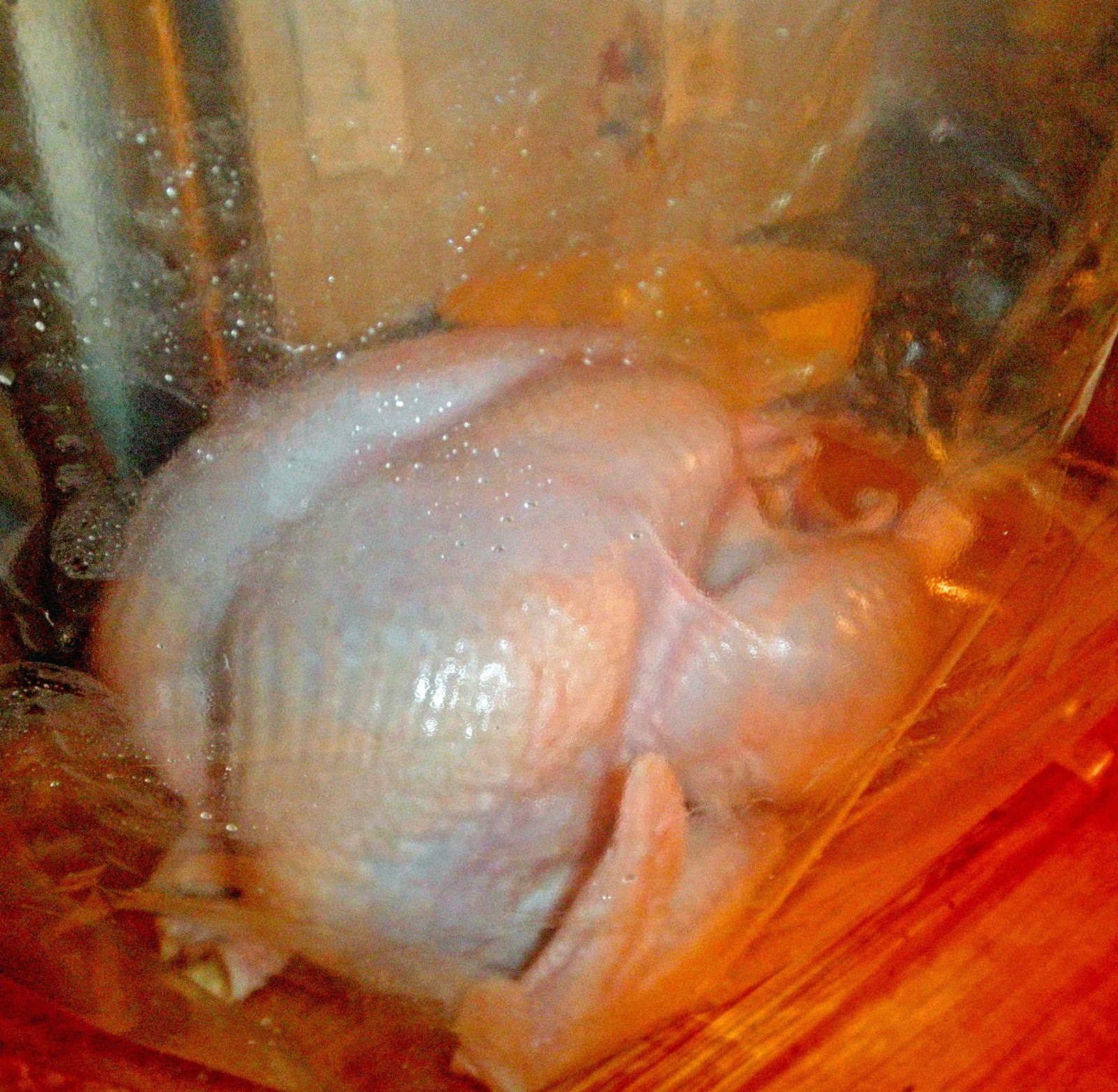
Steaming the Goose
Remove from the heat and let cool. Transfer the rack with the goose to a rimmed baking sheet and refrigerate uncovered overnight, until the skin is very dry, like parchment. Strain the pan juices and refrigerate. The strained juices will be used for the pan sauce.
Steamed Goose
Bring the goose to room temperature before roasting.  And now, the recipes.

ROASTED GOOSE WITH SPICES AND DRIED-FRUIT


Circa 2010
 
8oz dried figs, stems discarded
8 oz dried apricots (1 1/4 cups)
8 oz pitted prunes (1 1/4 cups)
1 tablespoon whole allspice
2 tablespoons mixed peppercorns (black, white, green, and pink)
1/2 stick (1/4 cup) unsalted butter, melted
1 (12-lb) goose that has been steamed; wing tips removed
2 medium onions, quartered
1/3 cup shallots, finely chopped
2/3 cup cognac
2 cups reserved goose pan juices from steaming the goose
1 Tablespoon arrowroot (or AP flour)
 
Prepare dried fruit:
Cover figs, apricots, and prunes with water in a 3-quart saucepan and simmer, covered, 20 minutes. Drain. Reserve 2 cups of fruit.  Thread remaining fruit onto 4 metal skewers.
 
Prepare goose:
Preheat oven to 350 degrees
 
Crack allspice and peppercorns using a mortar and pestle (or spread spices on a kitchen towel and crack with bottom of a heavy skillet).  Stir cracked spices into melted butter.
 
Prick goose skin, especially thighs and breast, all over with a metal skewer.  Do not puncture meat.  Season goose well with salt inside and out. Fold neck skin under body.  Put onions and the reserved 2 cups of fruit in cavity and tie legs together loosely with string. Rub skin all over with spiced butter.
 
Pre-Oven Goose With Peppercorn Spices
Roast goose:
Put goose on rack in roasting pan and roast in middle of oven 30 minutes. Reduce oven temperature to 325°F and continue to roast, basting goose and skimming off and reserving excess fat, every 30 minutes.
 
Arrange skewers with fruit on the rack around the goose.  Continue to roast goose, basting and skimming and reserving fat in same manner, until an instant-read thermometer inserted into fleshy part of a thigh (do not touch bone) registers 170°F and several fruits from bottom of cavity speared on thermometer register 160–165°F, about 1 hour more (juices will be slightly pink when thigh is pierced; temperature will rise to 175°F as goose stands).
 
Remove fruit from skewers and transfer to a bowl, or be creative and keep the fruit on two of the skewers and place skewers into goose. Transfer goose to a cutting board and let stand, loosely covered with foil, 30 minutes. Keep warm.

Make pan sauce:
Scrape the solidified fat off the refrigerated pan juices (the reminant juices from steaming the goose) and refrigerate for another use (roasting potatoes).   Put the rest of the pan juices into a measuring cup and set aside.
 
Pour off the fat in the roasting pan that was used to roast the goose.  Straddle the pan across 2 burners. Add shallots and sauté over moderately high heat, stirring, until golden, about 3 minutes. Add Cognac and deglaze pan by boiling and scraping up brown bits.  Add the reserved juices( from steaming the goose) to the pan and bring to a boil.  Pour the juices mixture into a saucepan.
 
Make a slurry of equal parts arrowroot and pan juice.  Add this into the saucepan and simmer, stirring, until slightly thickened, about 1 minute. Season with salt and pepper and strain through a sieve.  Keep warm.
 
To Serve:
Discard onions from cavity of goose and add fruit from cavity to the fruit in bowl, then keep warm, covered. Carve goose, cutting breast into 1/4-inch-thick slices. Serve fruit and sauce on the side.


ROASTED GOOSE WITH SPICES AND CITRUS -- NOT STEAMED

Roasted Goose with Spices and Citrus 2011
1 12-pound goose
4 lemons
3 limes
2 tsp sea salt
1 tsp five-spice powder
1 sprig each of parsley, sage, rosemary and thyme
2 Tablespoons clover honey
2 Tablespoons Thyme leaves

Using the tip of a sharp knife, lightly score the breast and leg skin in a criss-cross. This helps the fat to render down more quickly during roasting.

Grate the zest from the lemons and limes. Mix with 2 tsp fine sea salt, the five-spice powder and pepper to taste. Season the cavity of the goose generously with salt, then rub the citrus mix well into the skin and sprinkle some inside the cavity.
 
Scored Goose with Zest and Spices 2011
Stuff the zested fruit and the herb sprigs inside the bird and set aside for at least 15 minutes.

Heat oven to 350degrees.

Drizzle the goose with the honey and sprinkle with thyme leaves.  Place goose in oven.  Every 30 minutes turn goose 1/4 and baste.  Gather any goose fat and reserve for another dish--potatoes, maybe.  Total cooking time should be about 2 1/2- 3 hours.  At the end of the cooking time, leave goose to rest for about 20-30 minutes, covered loosely with foil.

Sunday, November 18, 2012

ROASTED BUTTERNUT SQUASH SOUP WITH SAGE AND NUTMEG CREME FRAICHE

 
Roasted Butternut Squash Soup
This is another one of those go-to soup recipes that I love to revisit in the fall and winter months.  I've been making Tom Keller's Roasted Butternut Squash Soup since I purchased his Bouchon cookbook in 2004  http://www.amazon.com/Bouchon-Thomas-Keller/dp/1579652395/ref=sr_1_1?ie=UTF8&qid=1353249126&sr=8-1&keywords=bouchon+cookbook.   Although I've seen many bloggers include this recipe on their sites, I also wanted to add it as a follow-up to my turkey and stuffing recipes to complete the Thanksgiving menu. 

To me, the most difficult part is cutting the neck off from the bulb of the squash.  The rest is easy. 
 
And over the years, I made some slight adjustments.  For example, I sometimes use sour cream in lieu of creme fraiche.  Also, I use more sage for roasting the squash.  Finally, I don't finish the soup with brown butter or chives, but I do add the crisped sage leaves as a garnish.

Ingredients:
1 3-to-3 1/2-pound butternut squash
2 tablespoons canola oil
Kosher salt and freshly ground black pepper
4 sprigs sage
1 cup thinly sliced leeks
1/2 cup thinly sliced carrots
1/2 cup thinly sliced shallots
1/2 cup thinly sliced onions
6 garlic cloves, smashed
2 tablespoons honey
6 cups vegetable stock, preferably home-made
Bouquet Garni made of 8 sprigs thyme, 2 sprigs Italian parsley,
2 bay leaves and 1/2 teaspoon black peppercorns, all wrapped in a
packet made of 2 green leek leaves
1/4 cup sour cream or creme fraiche
Freshly grated nutmeg
6 sage leaves and canola oil (for garnish)

Preheat the oven to 350 degrees. Line a small baking sheet with aluminum foil. Cut the neck off the squash and set it aside. Cut the bulb in half and scoop out and discard seeds. Brush each half inside and out with about 1 1/2 teaspoons of the canola oil. Sprinkle the cavities with salt and pepper and tuck sprigs of sage into each. Place cut-side-down on the baking sheet and roast until completely tender, about 1 hour. Remove the squash from the oven and let cool, then scoop out and reserve the flesh (discard sage).

Pre-Oven Squash With Fresh Sage
 
Roasted Butternut Squash
 
Roasted Butternut Squash
Meanwhile, using a vegetable peeler, peel away the skin from the neck of the squash until you reach the bright orange flesh. Cut the flesh into 1/2-inch pieces (there should be about 4 cups).
 
Prep for the "Un Roasted" Squash
Put the remaining canola oil in a stockpot over medium-high heat, add the leeks, carrots, shallots and onions and cook, stirring often, for about 6 minutes. Add the diced squash, garlic, dash of salt, and 1/2 teaspoon pepper and cook gently for 3 minutes, reducing the heat as necessary to keep the garlic and squash from coloring. Stir in the honey and cook, stirring, for 2 to 3 minutes. Add the stock and bouquet garni, bring to a simmer and cook for 10 to 15 minutes or until the squash is tender.
  
Squash Simmering
Add the roasted squash and simmer gently for about 30 minutes for the flavors to blend. Remove from the heat and discard the bouquet garni. Transfer the soup to a blender, in batches, and puree.
 
Puree Soup
 Strain the soup through a fine sieve into a bowl.
 
Pureed Soup
Place the creme fraiche in a small chilled bowl and stir in nutmeg to taste. Whisk until the creme fraiche holds a shape. Cover and refrigerate.

Heat 1/8 inch of canola oil in a small skillet.  When oil is very hot, add the sage leaves and cook turning the leaves to crisp them on both sides.  Drain the sage on paper towels.


Ladle the soup into serving bowls. Top each with a dollop of the nutmeg sour cream/creme fraiche and sage leaves. Serves 4.

TRADITIONAL AND NON-TRADITIONAL THANKSGIVING TURKEY


When I saw the Voltaggio Brothers' Thanksgiving episode last year where Chef Bryan made a traditional turkey that was coated in home-made herbed mayonnaise and Chef Michael made turkey parts with black pepper and crispy maple flakes in the sous vide immersion circulator, I was taken aback. My thoughts were mayonnaise as a coating for the turkey? Turkey parts cooked sous vide?  Both recipes piqued my interest, so I was game (no pun intended) and opted to give both a try.  So when I picked up the turkey from my butcher, I also purchased turkey drumsticks to cook a la sous vide.

First, each chef made a unique brine. And each one was unique.  I've brined many turkeys over the years, and it was typically done with salt, brown sugar and oranges.  Not these.  Bryan's brine was a process of cooking more ingredients than the entire turkey dinner and Michael's was another procedure where the brine was injected into the the turkey parts. 

For Bryan's traditional whole bird recipe, he made mayonnaise from scratch. I didn't.  I tried making my own mayonnaise but was unsuccessful (need more practice), so I used my number-one favorite prepared mayonnaise, Kewpie.  I know it's Japanese, but it is a good product and the only prepared mayonnaise that I use.  I added the fresh herbs to it and was ready to roast.  

And since I have a Sous Vide immersion circulator and a vacuum sealer, all I needed to complete Michael's recipe was a turkey brine injector and the maple flakes.  Although Michael butchered the turkey and made all of the parts separately, I only made the drumsticks. Shame on me.

The end result was good for both recipes. It was challenging, fun, and great-tasting turkey done two different ways.


Traditional Roasted Turkey
Recipe adapted from Bryan Voltaggio
Yield:  6-8 servings

For the Brine:
2 tablespoons canola oil
6 ounces chicken wings, halved at the joint
1 turkey neck
1/4 cup carrots, diced
1/4 cup celery, diced
1/4 cup onions, diced
1/2 cup red wine
1 tablespoon soy sauce (preferably Tamari)
3 allspice berries
3 cloves garlic, smashed
2 whole cinnamon sticks
2 sprigs fresh marjoram
2 sprigs fresh thyme

For the Turkey:
One 10-12 pound fresh turkey
1teaspoons sea salt
1/2 teaspoon freshly ground black pepper
5 sprigs fresh marjoram
3 sprigs fresh sage
2 sprigs fresh rosemary
2 green apples, sliced
1 Spanish onion, julienned (about 1 cup)
4 cloves garlic, smashed (about 1 1/2 Tablespoons)
1 cup Herb Mayonnaise (prepared mayonnaise with 1 tablespoon of chopped fresh marjoram, sage, thyme, 2 oz freshly squeezed orange juice and a dash of Kosher salt and freshly ground black pepper)

Brine: In a large Dutch oven or stock pot, heat the oil over medium-high heat. Add the chicken wings and neck of the turkey and cook, stirring occasionally, until dark brown and roasted, about 10 minutes.

Browning Wings and Neck
Add the carrots, celery and onions and continue cooking until golden, another 5 to 7 minutes. Add the wine and scrape the bottom of the pot with a wooden spoon to release all bits.  Add 1 quart cold water, the soy sauce, allspice berries, garlic, cinnamon, marjoram and thyme. Bring to a boil. Once the liquid has boiled for 5 minutes, stir well and let cool.   Once cooled, strain out the solids and reserve.

Turkey:  Put the brine and the turkey into a brining bag and seal.

Turkey in Brining Bag
Allow the turkey to brine for 12 hours in the refrigerator before cooking. Rinse the turkey to remove the excess brine and pat dry with towels. Reserve about 1/2 cup of the brine for basting. Let the turkey stand uncovered at room temperature for 1 to 1 1/2 hours.

Position a rack in lower third of the oven and preheat to 425 degrees

Place the reserved brine solids on the bottom of a roasting pan. Then fit the roasting rack over the solids. Sprinkle the turkey cavity with the salt and pepper. Place the marjoram, sage, rosemary, apples, onions and garlic inside the cavity. Truss the turkey with kitchen twine. Coat the turkey evenly with the Herb Mayonnaise.

 
Turkey Coated in Herb Mayonnaise
Place the turkey, breast-side up, on the rack in the roasting pan and roast for 30 minutes. Reduce the heat to 325 degrees F and roast for about 1 1/2 hours more.  Baste every 15 minutes with the drippings and leftover brine Continue roasting until an instant-read thermometer inserted into the thigh registers 165 degrees F. Total roasting time should be 3 to 3 1/2 hours.

Remove the turkey from the oven and allow it to rest about 15 minutes. Cut and discard the kitchen twine and carve. Serve with gravy.
 
Roasted Turkey
Turkey Drumsticks with Black Pepper and Maple Flakes
Recipe adapted from Michael Voltaggio
Yield:  4 drumsticks

For the Brine:
4 cups apple cider
1/4 cup kosher salt
1/4 cup maple syrup
1/4 cups black peppercorns
2 bunches thyme

For the Turkey:
4 turkey drumsticks
1 Tablespoon freshly ground black pepper
2 Tablespoons maple flakes
Canola oil


Brine: In a large stockpot over high heat, combine, the apple cider, 4 cups water, kosher salt, maple syrup and black peppercorns. Bring to a boil and then reduce the heat and simmer for 5 minutes. Turn off the heat, add all but 2 sprigs of the thyme, and let the mixture cool. Refrigerate the brine until thoroughly chilled.

Turkey: When the brine has chilled, fill a turkey brine injector with liquid. Insert the injector into the turkey drumsticks, filling each with brine.


Transfer the turkey pieces to a vacuum seal bag and seal according to manufacturer's instructions. Refrigerate for 24 hours.


Prepare a sous vide immersion circulator for use according to the manufacturer's instructions. Preheat the water to 150 degrees F.

Add the pepper and maple flakes to a coffee or spice grinder. Pulse until ground and completely mixed together. Pour the mixture into a large bowl. Place the drumsticks into the mixture and toss to coat. Place each drumstick into a separate vacuum-sealable bag. Using a vacuum sealer, vacuum and seal the bags as instructed above. Place the bags into the circulating water and cook for 2 hours. Remove from the water.

Just before serving, preheat oil in a deep fryer or large, heavy-bottomed pot to 375 degrees F. Remove the turkey pieces from the bags and pat dry. Fry drumsticks until golden and crispy, about 5 minutes per piece. Transfer to a carving board.

Friday, November 16, 2012

TRADITIONAL THANKSGIVING BREAD STUFFING


 Stuffing Mixed and  Ready for the Oven
When I was growing up as a kid, every Thanksgiving my mom always made a traditional bread stuffing with celery, onions, salt, pepper, dried thyme and, of course, cooked turkey giblets. 

And throughout the years, I have made a variety of my own stuffing, some of which have included wild rice, dried cranberries, dried apricots, apples, wild mushrooms, and Hawaiian sweet bread (not all at the same time).

However, for the past several years, I came back to the classic and revived my mom's bread stuffing with a few minor adjustments.  This is another one of those recipes that probably has hundreds--if not, thousands--of variations, but it certainly works.

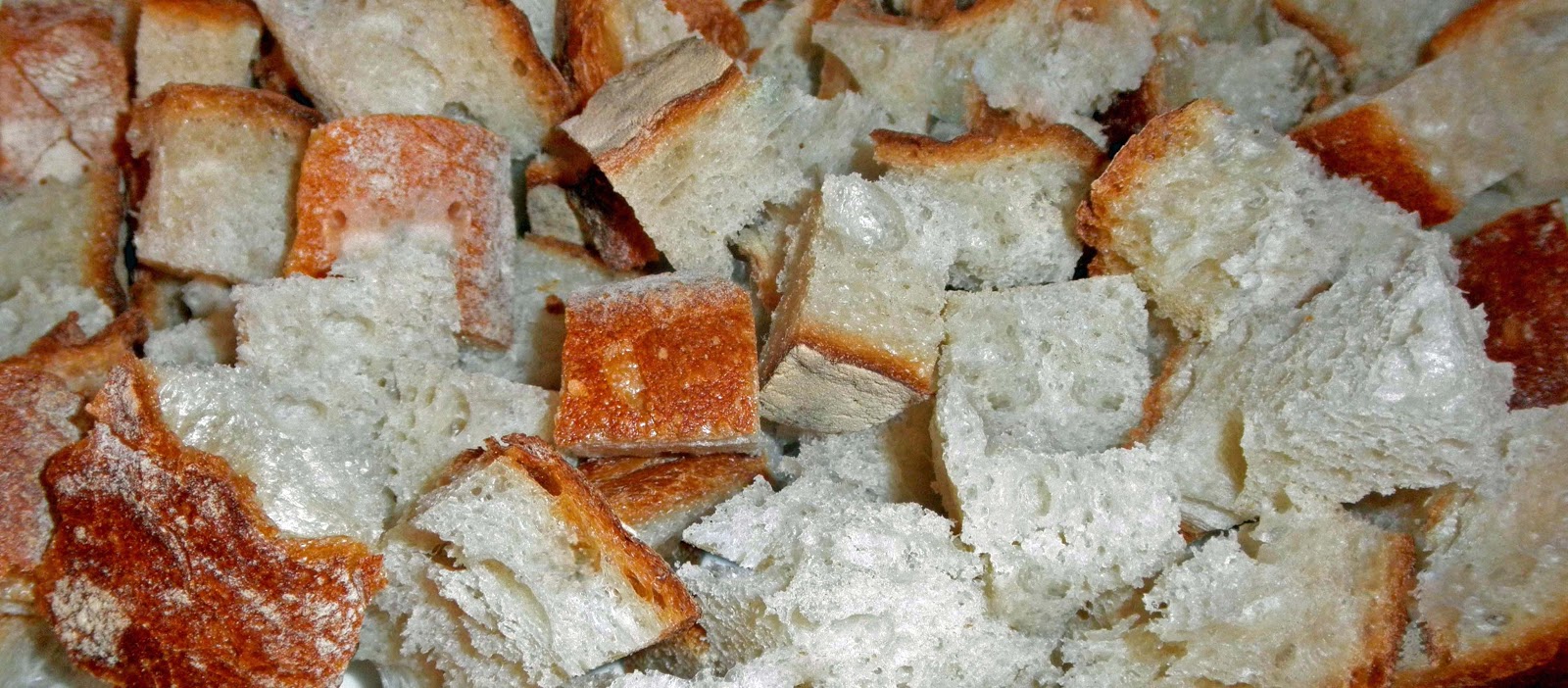
The bread.  In my opinion, the stuffing is only as good as the bread.  I have learned that a heartier, artisan-style loaf of bread produces a much better stuffing versus the "sliced" stuff that my mom used, although sometimes she would use seeded hard rolls from the bakery.  I don't think the term artisan existed back then.

The Bread

Cubed Bread
Celery, onions, and herbs.  The celery and onions never change here and will always be staple ingredients.  However, I did get a little more creative with the herbs. In lieu of dried thyme, I use fresh (although dry would certainly work).  Also, I added fresh sage to the mix (again, dried could probably work, as well).  Then some celery seeds (which, sort of, "take the place" of the poppy seeds from the rolls), and, finally, two of the "classic" fall spices that scream Thanksgiving, freshly-grated nutmeg, and cloves. 


Celery, Onion and Spice Mix
No giblets, salt, or eggs.  We made turkey stock using the giblets, so the "cooked meat" will be used for gravy and not in the stuffing.  Salt is not necessary because of the ingredients used and there is no need to add any more sodium to this. And, although many stuffing recipes call for eggs, the turkey stock works well to bind the stuffing for. . . The Finale . . . 

To Stuff or Not to Stuff?  So, where do we put the stuffing--inside the turkey or bake it in a separate dish? I opt to do the latter.  Although, of course, the stuffing could always be loosely placed in the turkey, and the leftover stuffing baked separately.  When the stuffing is baked in a separate dish, turkey stock is used to moisten it so it could absorb the juices that would have come from the turkey if the stuffing was inside the bird.


Traditional Bread Stuffing

1/2 cup (1 stick) butter, unsalted
3 cups onions, chopped
2 cups celery, scraped to remove stringy outer portion and chopped into 1/4 inch pieces
1 1/2 Tablespoons fresh thyme, chopped
1 1/2 Tablespoons fresh sage, chopped
2 teaspoons celery seeds
Pinch of nutmeg, freshly ground (about 1/16th teaspoon)
Pinch of ground cloves (about 1/16th teaspoon)
1 one-pound loaf of day-old bread, cut into 1/2-inch cubes, toasted if fresh
1/2 teaspoon freshly ground black pepper
2 1/2 cup home-made turkey broth (made from the turkey giblets)

Melt 1/4 cup butter in a large skillet over medium heat.  Add the onions, celery, thyme, sage, celery seeds, nutmeg, and cloves.  Cook mixture until softened, about 5 minutes.  In a large bowl, toss the cooked vegetables with the bread cubes.  Season with the pepper.  Melt the remaining butter and pour it over the stuffing with 1/2 cup of home-made turkey broth.  The stuffing should hold together.

Place stuffing in a baking dish and pour about one or two cups of the turkey broth over the stuffing to moisten.  Bake, covered, in a 325 degree oven, for about an hour.  For a "crunchy" top, uncover for the last 15 minutes of baking. 

Yields about 12 cups


Finished Baked Stuffing


Monday, November 12, 2012

SWEET POTATO WAFFLES WITH BOURBON MAPLE SYRUP

Sweet Potato Waffles
My idea of waffles was always those frozen packaged things that we would pop into a toaster for several minutes and when they were "done", we would smother them with Aunt Jemima's syrup and chunks of hard butter that never really melted.  I think the last time that I had one of those waffles was about 30 years ago.

Since then, and as the items in my kitchen continued to grow throughout the years, I still peruse the cooking sections of major department stores, specialty cooking stores, and even the discount stores, seeking for a new kitchen item that I don't own.  Although I've seen many waffle irons, I never really thought about purchasing one or making waffles from scratch--until a few weeks ago when I saw a cooking episode featuring Chef Jesse Jones on the CBS Morning Show.  Chef Jesse Jones, who is one of New Jersey's top chefs and the 2010 Ultimate Chef of Bergen County, made Sweet Potato Waffles.  Chef Jesse owns a catering business and teaches cooking classes throughout the state and has been featured on the show quite frequently.  I tasted his extreme comfort food several times and it is delicious, so his recipe for Sweet Potato Waffles got my attention.  The following day I purchased a waffle iron. 


After about a week of the iron sitting on my counter, it was time to make the waffles.  Although I had most of the dry ingredients in my pantry, I adapted the recipe slightly to use the items that I had on hand and purchased those that I didn't.  For example, I used pancake mix and a vanilla bean in lieu of the pastry flour and vanilla extract, respectively.  And eggs and butter are always core staples in the fridge, but I did need to purchase buttermilk.

I also did some research and came across a recipe for Bourbon Maple Syrup on the Bon Appetit website.  Bourbon is always a staple on the bar, particularly in the fall and winter months, and espresso is another staple that is always in the kitchen. It all came together.   I also made a side dish of braised wild mushrooms which were a perfect accompaniment to the dish. 

After dinner, the storm hit. 

Sweet Potato Waffles
Adapted from Chef Jesse Jones of Chef Jesse Concepts and owner of Heart and Soul Catering

Yield: 4-5 waffles per batch

2 cups pancake mix
3 teaspoons baking powder
1/2 teaspoon salt
1 teaspoon ground cinnamon
1 teaspoon allspice
1 Tablespoon granulated sugar
2 teaspoons light brown sugar
3 egg yolks, separated, reserve egg whites
1 1/2 cups buttermilk
1/2 cup unsalted butter, melted
1/2 cup vegetable oil
1/2 teaspoon pure vanilla extract, or seeds scraped from one vanilla bean
1 small sweet potato - baked, peeled and mashed (4-6 oz)
Vegetable oil in a spray pump (or unsalted melted butter) to coat waffle iron

Pre-heat oven to 200 degrees and pre-heat the waffle iron. 

Sift together the pancake mix, baking powder, salt, cinnamon, allspice, and both sugars in a medium bowl.

Separately, in another medium bowl, combine egg yolks, buttermilk, melted butter, oil, vanilla  extract (or seeds scraped from the vanilla bean) and mashed sweet potato.

Add the liquid ingredients to the dry ingredients and mix gently until combined. 

Beat the reserved egg whites until frothy and fluffy.  Gently fold egg whites into the waffle mix.  Let batter rest for about 5 minutes.


Spray waffle iron with oil (or brush with melted butter).  Ladle 4 to 6 oz of batter into iron and close.  Follow cooking instructions according to manufacturer's directions. As each waffle is done, remove from waffle iron and put each one on a cookie sheet and place in oven to keep warm. 

Remove waffles from oven.  Place on individual serving dishes and drizzle with Bourbon Maple Syrup.

Bourbon Maple Syrup
Adapted from bonappetit.com

Yield:  3/4 cup

1 cup brewed espresso coffee
6 Tablespoons pure maple syrup
3 Tablespoons (packed) dark brown sugar
1/2 teaspoon espresso coffee powder
1/3 cup bourbon
2 Tablespoons unsalted butter

Stir coffee, maple syrup, and sugar in a medium saucepan over medium-high heat until sugar dissolves. Bring mixture to a boil; cook until thickened and reduced by half, about 6-7 minutes.  Remove syrup from heat; add bourbon and 2 tablespoons butter. Reduce heat to medium and simmer until sauce is reduced to about 3/4 cup, about 40-45 minutes.  The mixture should be thick enough to coat a spoon, but not sticky, and will thicken as it cools.